AI Website Optimization: Making Your Site AI-Friendly to Get Recommended by AI Platforms

AI website optimization means structuring your site so large language models and AI-driven answer systems can accurately understand, cite, and recommend your content, increasing visibility and high-intent leads. This guide explains why AI-driven recommendation is displacing traditional ranking, how AI systems evaluate web content through entity recognition and context, and which practical technical and content changes matter most for 2025 and beyond. Readers will learn an actionable semantic content strategy, the technical checklist for AI crawler accessibility, and trust-building steps that help AI systems surface and validate your brand. We also map how an AI Visibility Audit converts diagnosis into a prioritized plan and where strategic services like AI Visibility Systems, AI Content Engine, Authority Signal Stacking, and Multi-Platform Syndication fit into an implementation roadmap. Throughout, targeted keywords such as ai-friendly content, ai website optimization, Answer Engine Optimization, and E-E-A-T for AI are used naturally to illustrate concrete tactics you can apply immediately. By the end you will understand the mechanisms AI uses, a step-by-step audit pathway, and the minimum structural investments required to be recommendation-ready.
Why Is AI Search the New Frontier for Business Visibility?
AI search is the new frontier because modern answer engines move from ranking URLs to synthesizing, citing, and recommending entities based on semantic understanding, and that shift directly changes how businesses are discovered and trusted. Mechanistically, AI systems parse entities, prioritize context and intent, and favor concise, well-structured content that can be cited as a source; the direct benefit is higher-quality, high-intent exposure without paying for clicks. This change matters for companies that rely on organic discovery because AI overviews and zero-click responses concentrate attention on a small set of trusted sources. The next section contrasts these signal and outcome differences with traditional SEO to clarify what to keep and what to change for AI visibility.
AI-driven discovery differs from traditional SEO in several structural ways and requires different content behaviors than keyword-centric optimization. First, AI systems emphasize semantic coherence and entity authority, while classic SEO often emphasizes keyword placement and backlinks. Second, output formats change — concise citations and recommended snippets replace ranked listings with many clicks. Third, user intent modeling is deeper: AI systems synthesize context across sessions and sources, shifting value to trustworthy, well-structured pages that answer specific queries. Understanding these differences helps prioritize work for AI website optimization rather than repeating legacy SEO tactics.
Key AI search statistics for 2025 illustrate urgency and where to focus attention. Recent market analysis shows a significant share of discovery moves to AI-driven overviews and assistant responses, reducing traditional organic click-through rates and increasing the proportion of impressions that result in zero-click answers. AI recommendation models increasingly cite fewer, higher-quality sources for overview answers, magnifying the impact of trust signals. For businesses, these shifts mean that being cited by an AI overview often delivers fewer but much higher-intent leads, so the opportunity cost of waiting to optimize is rapidly rising. These trends make it essential to adopt AI-friendly content and technical practices now to retain visibility.
How Does AI Evaluate and Understand Your Website?
AI evaluates websites by extracting entities, mapping relationships between concepts, assessing context and intent alignment, and scoring trust signals such as authoritativeness and freshness; this pipeline determines whether content is citation-ready and recommendation-worthy. The mechanism relies on entity recognition as the building block, semantic triples for relationship mapping, and context matching to the user’s query intent, producing a ranked list of candidate sources that can be synthesized into an answer. The practical benefit is that sites structured for entity clarity and factual backing are far more likely to be cited by AI platforms. The following subsections show semantic triples and intent matching steps AI uses to decide when to cite a page.
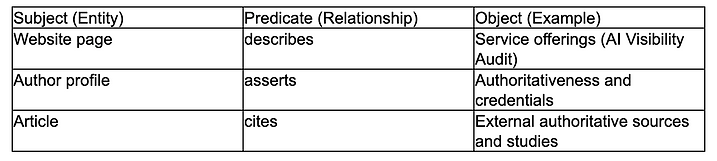
Semantic understanding depends on consistent entity labeling and clear semantic triples so that AI maps your site’s offerings into knowledge graphs it can trust. Entities (people, products, services) need explicit, repeated signals — headings, schema, and contextual mentions — so predicates like "provides" or "is an" connect subjects to objects reliably. For example, a semantic triple such as "Company X → offers → AI Visibility Audit" allows AI to map that service into a recommendation pathway. Consistent entity usage and schema markup increase the chance that AI systems will select and cite your content, and the next paragraph explores how context and intent inform that selection.
AI interprets user intent and context by combining query semantics, session signals, and content framing to match user needs with the most relevant sources. Intent classification typically separates informational, transactional, and navigational goals, and AI uses content features — structured answers, clear metadata, and topical depth — to decide which pages satisfy those intents. Practical examples include conversational queries where AI favors concise definitional paragraphs and transactional queries where it prioritizes pages with clear service descriptions and trust signals. Aligning content structure and phrasing with the likely intent categories increases the probability of recommendation and sets the stage for optimizing site architecture accordingly.
What Is MediaDrive AI's Approach to Optimizing Websites for AI?
MediaDrive AI approaches AI website optimization through a structured sequence: diagnose current AI visibility, re-engineer site architecture and messaging, create citation-ready content, and amplify authority through strategic publishing and syndication. The diagnostic entry point is the AI Visibility Audit, a 30-minute session designed to assess a brand's current AI visibility and provide a prioritized action plan; this quick assessment surfaces gaps in entity clarity, schema, and trust signals. Following diagnosis, MediaDrive AI implements AI Visibility Systems to re-engineer sites and messaging, then uses the AI Content Engine to produce snippet-optimized content, and layers Authority Signal Stacking with Multi-Platform Syndication to build distributionary trust. This method ensures each technical and content change maps directly to signals AI systems use to recommend sources.
How AI Visibility Systems re-engineer sites and messaging focuses on structural changes that make content machine-readable and citation-ready while preserving human readability. Systems-level changes include semantic heading hierarchies, canonicalization policies, predictable URL patterns for entity pages, and consistent on-page entity descriptors that AI can parse easily. Messaging is rewritten to present concise, factual paragraphs that answer common queries directly and contain clear entity references. These modifications reduce ambiguity for AI crawlers and increase the chance of extraction as a cited source, and the next subsection covers how content is created to be citation-ready.
The AI Content Engine centers content production on entity-first templates, snippet-optimized paragraphs, and evidence-backed passages to increase citation probability by AI systems. Content templates prioritize short, declarative sentences that state relationships (Entity → provides → Benefit), include structured data in JSON-LD, and place factual claims near corroborating citations. Freshness strategies — a cadence for updates — keep content timely, which AI models often weight when preferring sources. When content is built this way, it becomes not just discoverable but also usable for answer engines that need concise, verifiable snippets to incorporate into synthesized responses.
Authority Signal Stacking and Multi-Platform Syndication build external corroboration and distribution pathways that AI systems use as trust signals. Stacking involves sequencing publications and citations across high-trust platforms so that AI crawlers encounter consistent, corroborated claims about your entity. Syndication distributes citation-ready content to platforms where AI models crawl and where authoritative citations are more likely to appear. Together, these tactics increase the number and quality of external signals that reinforce on-site entity assertions, which makes AI recommendation more probable and resilient. The next major section lays out the reusable pillars you should implement yourself.
What Are the Key Pillars of an AI-Friendly Website?
An AI-friendly website rests on three pillars: semantic content, technical accessibility, and demonstrated trust (E-E-A-T for AI). Semantic content means entity-first writing and structured answers that map to knowledge graphs; technical accessibility ensures AI crawlers can retrieve and parse content reliably via schema and crawl directives; trust combines author and source signals, citations, and case evidence that AI uses to score authority. These pillars work together: clear entities + accessible content + corroboration create the signal stack AI uses to surface recommendations. The subsections below explain how to build each pillar in practice.
Semantic content strategy starts with topic clustering and explicit entity mapping to create hub-and-spoke content that AI can traverse and cite. A hub page defines the core entity concept while spokes cover specific attributes, each using consistent entity names and schema types. Content templates should include a short definitional paragraph, a mechanism/benefit sentence, and a concise data-backed snippet for citation. Following this pattern helps AI systems extract discrete facts and relationship triples, increasing citation likelihood and guiding future content updates.
Technical optimizations improve AI crawler accessibility by implementing structured data, clean HTML, explicit crawl directives, and performance best practices so AI systems can retrieve and understand content at scale. Recommended schema includes organization, person/author, service, and FAQ markup where appropriate, combined with a robots policy and an llms.txt equivalent to guide model-specific crawling when applicable. Performance improvements — reduced render-blocking scripts and server-side rendering for key pages — further ensure content is accessible to parsers. These technical steps reduce parsing ambiguity and raise the probability that AI systems will index and cite your pages.
Building E-E-A-T for AI focuses on surfacing author signals, case studies, and corroborating citations that AI models use as trust indicators. Tactics include structured author bios with credentials, time-stamped case studies with measurable outcomes, and external citations to recognized authorities. When combined with on-site schema types like Author and CaseStudy, these tactics create explicit signals for AI to weigh when assembling recommendations. The following table compares the pillar attributes and practical actions for site owners.
How Can You Schedule and Benefit from an AI Visibility Audit?
An AI Visibility Audit is a focused diagnostic that identifies the highest-impact gaps in entity clarity, schema, content snippets, and external signals, producing a prioritized action plan that your team can execute. The audit is designed as a 30-minute assessment to map current AI visibility and recommend quick wins and medium-term system changes; the outcome is a prioritized checklist that aligns technical fixes and content updates to measurable signals AI uses. Scheduling the audit is urgent because early diagnosis captures low-hanging fruit and prevents loss of recommendation share to competitors. The next paragraphs explain why urgency matters and what to expect during the process.
Scheduling an AI Visibility Audit is urgent because AI recommendation dynamics compress the window for establishing authority: the faster you secure citation-ready content and trustworthy signals, the more likely you are to be included in early overviews and assistant responses. Competitors who move faster to clarify entities and stack authority will capture a larger share of high-intent exposure, making delay a direct source of lost leads. For organizations balancing resources, the audit identifies high-impact, low-effort actions first so teams can protect visibility quickly while planning deeper system changes.
What to expect during the 30-minute AI Visibility Audit process is a concise sequence of discovery, gap analysis, and prioritized recommendations that result in a short, actionable plan. The audit typically covers current entity mapping, schema coverage, content snippet readiness, and external signal gaps, then recommends quick wins — for example, adding schema to key pages or rewriting a definitional paragraph for citation readiness — followed by system-level actions. The deliverable is a prioritized action plan with immediate next steps and a recommended implementation sequence to improve AI citation likelihood. The following table clarifies audit components and outcomes.
What Are the Frequently Asked Questions About AI Website Optimization?
This FAQ section addresses practical, high-intent questions about optimizing sites for AI search and the difference between AI SEO and traditional SEO. Each answer is concise and action-focused so it can be used for PAA or FAQ schema.
How Do I Optimize My Website for AI Search?
Optimizing for AI search requires three core steps: clarify entities and their canonical pages, structure short citation-ready answers near the top of pages, and implement comprehensive schema to expose relationships. Start by mapping primary entities and ensuring each has a single authoritative page with consistent naming. Next, craft a short definitional paragraph that answers common queries directly and includes factual backing. Finally, add JSON-LD schema (Organization, Service, Author) so AI parsers can confirm relationships and provenance.
What Is Answer Engine Optimization and How Does It Work?
Answer Engine Optimization () focuses on structuring content so AI-driven systems can extract concise, verifiable answers and cite your site as the source. It works by combining short, factual snippets, structured data, and corroborating external citations to create citation-ready material that AI systems can synthesize. Core tactics include writing direct answers, marking them with or schema, and ensuring claims are supported by evidence or authoritative references to increase trust.
What Is the Difference Between Traditional SEO and AI SEO?
Traditional SEO concentrates on rankings, keywords, and backlink signals, whereas AI SEO emphasizes entity clarity, semantic relationships, and citation-readiness for synthesized answers. Keep proven SEO fundamentals such as content quality and performance, but shift priorities to explicit entity pages, structured data, and short, factual snippets that AI systems can easily extract. This change rebalances effort from broad keyword capture toward high-quality, trustable content that maps cleanly into knowledge graphs.
How Can AI Improve My Website's Visibility and Lead Generation?
AI improves visibility by surfacing concise recommendations and citations that match high-intent queries, often producing fewer but better-qualified leads that convert at higher rates. Mechanisms include improved intent matching, citation-based authority, and synthesized overviews that steer users to actions without broad browsing. To translate visibility into leads, optimize landing pages for transactional intent, include clear service descriptors, and use the audit to identify where AI citation is most likely to drive conversions.
-
Quick Wins List: Immediate actions to increase citation probability:Add JSON-LD schema for core entities on high-traffic pages.Rewrite definitional paragraphs into concise, factual snippets.Publish author bios and case summaries to strengthen trust signals.
-
Strategic Steps List: Mid-term projects for sustained AI visibility:Implement hub-and-spoke semantic clusters for core service areas.Establish a cadence for updating citation-ready content to maintain freshness.Plan a syndication sequence across authoritative platforms for signal stacking.
-
Implementation Checklist: Audit-to-action sequence:Book a 30-minute AI Visibility Audit to identify immediate gaps.Apply prioritized quick wins (schema, snippets, author signals).Schedule system-level work (AI Visibility Systems, AI Content Engine, Authority Signal Stacking).
Following this checklist converts diagnosis into measurable action and helps protect and expand AI-driven discovery over time. If you need an expert partner, MediaDrive AI offers the audit and the systems described here to help teams implement these steps efficiently.